
Lamar County Sex Offender Checks
Alabama Law Enforcement Agency, or ALEA, manages the official Alabama Law Enforcement Agency Sex Offender Registry. Local agencies collect registration data, photos, fingerprints, and changes, then submit that material to ALEA. A Lamar County sex offender lookup should begin at an official ALEA registry page, not at a private people-search site. ALEA says its data updates in real time from local agency submissions. Even so, a listed address comes from required reporting. It is not a live observation of where someone is at each moment.
Three records answer different questions. The registry shows public registration and notice data. A Lamar County court file shows the charge and disposition behind a case. An ALEA fingerprint self-review shows a person their own state criminal-history record. A missing public registry result cannot prove that no sexual-offense history exists because Alabama law limits public display for some records and statuses. For an underlying judgment, use the Lamar County court case lookup.
ALEA's Lamar Registry Gateway
The safest route is the ALEA Community Information Center. It connects the public with Alabama registry, fugitive, missing-person, and alert resources. ALEA directs registry users to a state-authorized Community Notification system. During research, that vendor stopped automated inspection behind a JavaScript and anti-bot gate. Exact field names, distance choices, and map controls could not be verified, so none should be assumed.
If the state-authorized screen will not load, use a current browser with JavaScript enabled. A second official route is the U.S. Department of Justice search described below. Do not treat a technical failure as a registry result. Lamar County has no verified sheriff-hosted offender map, local online list, or mobile app. The absence of those tools makes ALEA the main public state layer.
The ALEA registry overview is shown below. It provides the state context that should frame any Lamar County sex offender search.
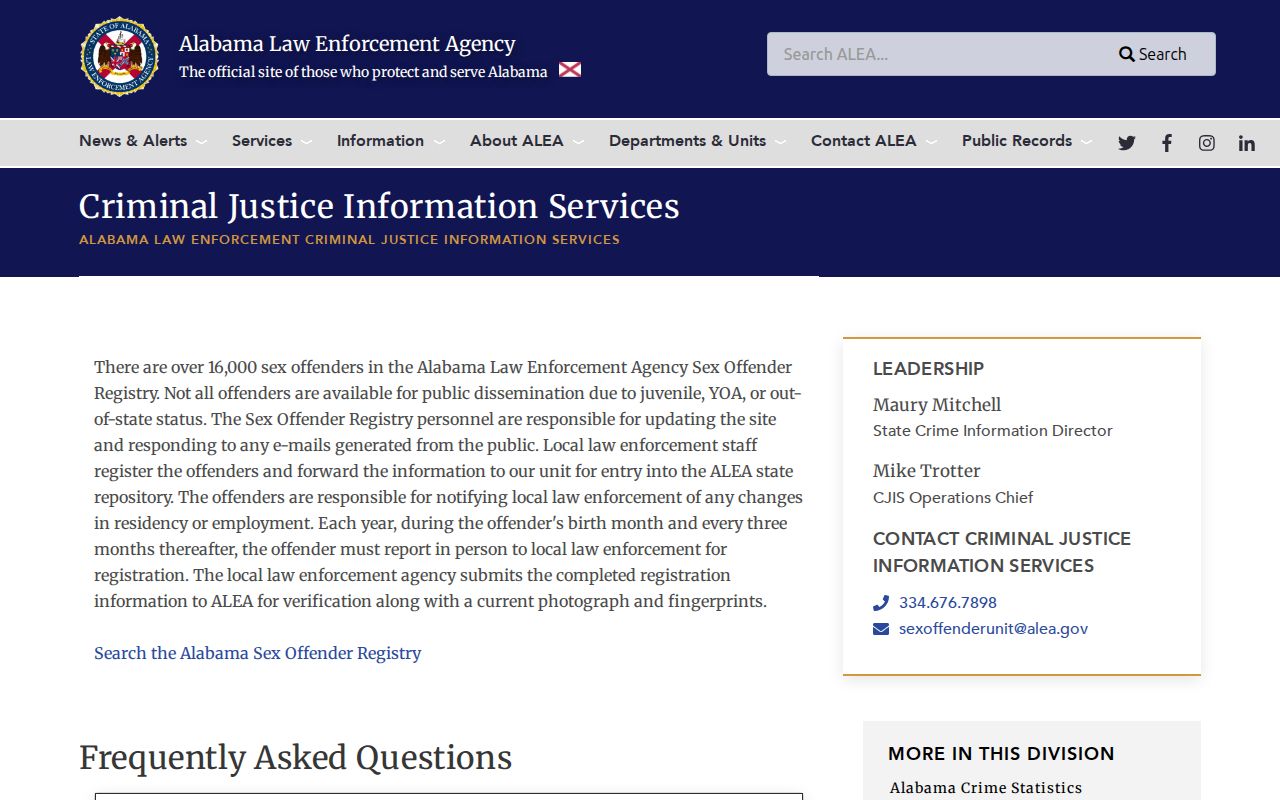
The official overview helps users distinguish ALEA information from unrelated commercial pages with similar wording.
Alabama Law Enforcement Agency Sex Offender Registry Searches
A careful Lamar County registry search uses only controls that the live state-authorized interface presents. The research verified the entry route, but the vendor gate blocked a reliable inventory of its current labels. Start with a name or place detail you already know, avoid speculative matches, and open only enough information to understand the public record. Then read the status and update information the profile actually displays.
- Enter through ALEA's official registry gateway and follow its link to the authorized search. Review the conditions displayed there.
- Use the most reliable non-sensitive name or location facts available. Follow only the field labels and options shown on the live form.
- Compare results with care. Do not assume two people with similar names are the same person.
- Read the full public profile, including its status and update data. Confirm a suspected error or violation with law enforcement.
| Search Element | Type | Required | Notes |
|---|---|---|---|
| ALEA entry link | Official gateway | Yes | Use ALEA to reach the authorized vendor. |
| Live vendor fields | Interactive form | As displayed | Current labels and required markers were blocked during inspection. |
| Name or location facts | User input | As displayed | Use only reliable facts and the controls shown live. |
| NSOPW name or place | National search | As displayed | Use for an official cross-state layer. |
The field limits matter. Claiming that Lamar County registry users can filter by a set radius, map zone, ZIP code, or county would go beyond the inspected evidence. Search only what the active form permits.
Lamar Registry and NSOPW
The National Sex Offender Public Website, or NSOPW, is operated by the U.S. Department of Justice. It searches participating public registries across jurisdictions. That makes it useful when a Lamar County sex offender lookup may involve another state. ALEA remains the right source for Alabama-specific explanations, forms, and local reporting duties.
Neither layer replaces the other. Start with ALEA for Alabama context. Add NSOPW when movement across state lines or a broader location search matters. Public systems still reflect each jurisdiction's disclosure law, so no result is not proof that no record exists. A court file remains the source for the underlying conviction and disposition.
The DOJ national registry site appears below as the cross-jurisdiction option for Lamar County residents.
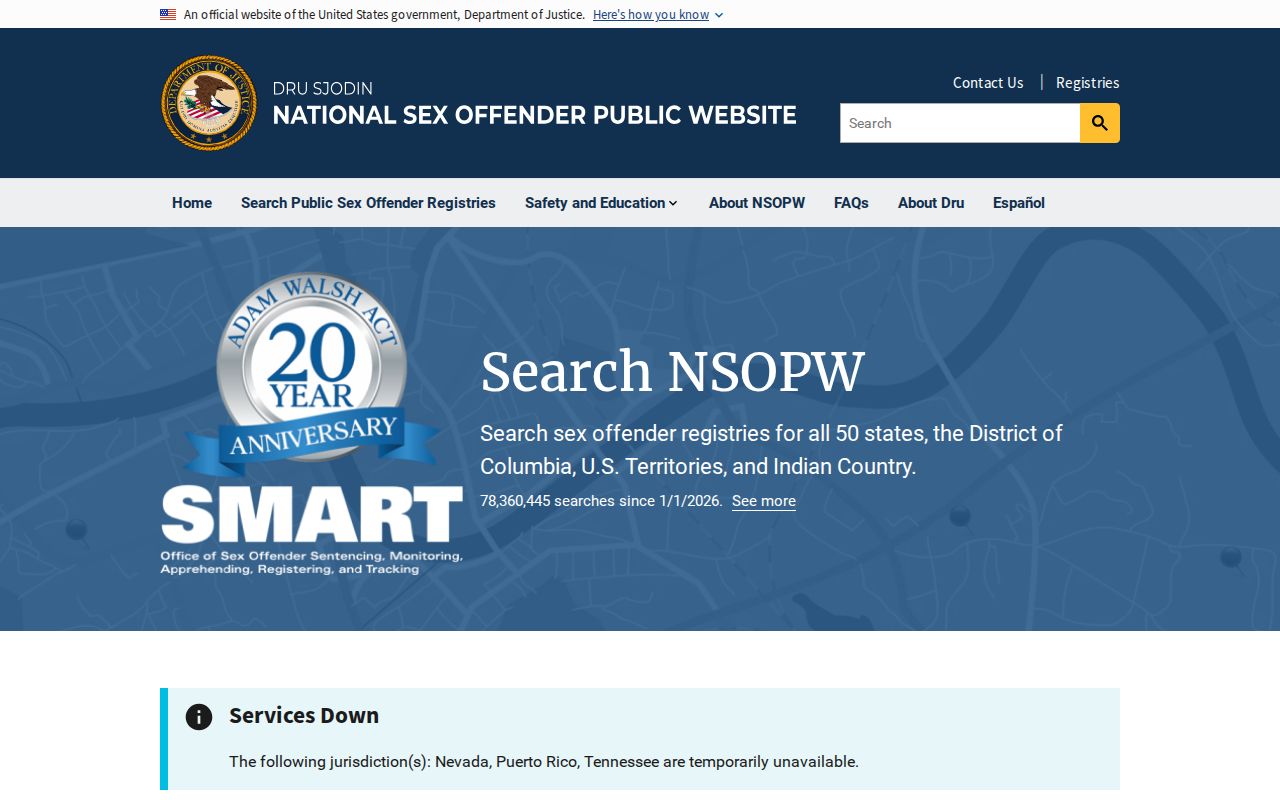
This national layer broadens the geographic search while leaving Alabama registration questions with ALEA and local law enforcement.
Registry Profiles: What They Show
Alabama Code §§ 15-20A-7 and 15-20A-8 define the information collected for registration. The public portion of a Lamar County registry profile can identify a person and describe required registration facts. It is not a full rap sheet. It also does not predict future conduct. Read each field as a reported registry fact, and pay close attention to status and update information supplied on the live profile.
| Name & Aliases | Primary name and reported aliases used to identify the registrant. |
|---|---|
| Photo & Description | Current submitted photo and physical descriptors required by law. |
| Residence Status | Reported residence or homeless status, subject to update and verification limits. |
| Qualifying Offense | The conviction or offense tied to the registration duty. |
| School & Vehicles | Required school information plus vehicle description, registration, and location data. |
| Registration Status | Public compliance or registration information shown by the active profile. |
Internet identifiers and other required information may also form part of the registry record. Public visibility still depends on Alabama law. A registry page should never be treated as a complete criminal-history report.
Limits of Lamar Registry Results
Not every sexual conviction appears on the public Alabama registry. ALEA identifies several legal distinctions. A first conviction for indecent exposure or sexual misconduct can require registration and verification without public posting. Juvenile adjudications are generally not public unless high-risk notice is ordered. Youthful-offender treatment can also affect display.
Out-of-state, federal, military, and tribal cases can raise due-process questions that affect dissemination. Those limits explain why a Lamar County no-match result has a narrow meaning: the terms entered did not return a public profile at that time. It does not certify a person as having no sexual-offense history, and it does not disclose law-enforcement-only material.
ALEA also publishes registration forms, legal information, and safety material. The official resource set is shown below.
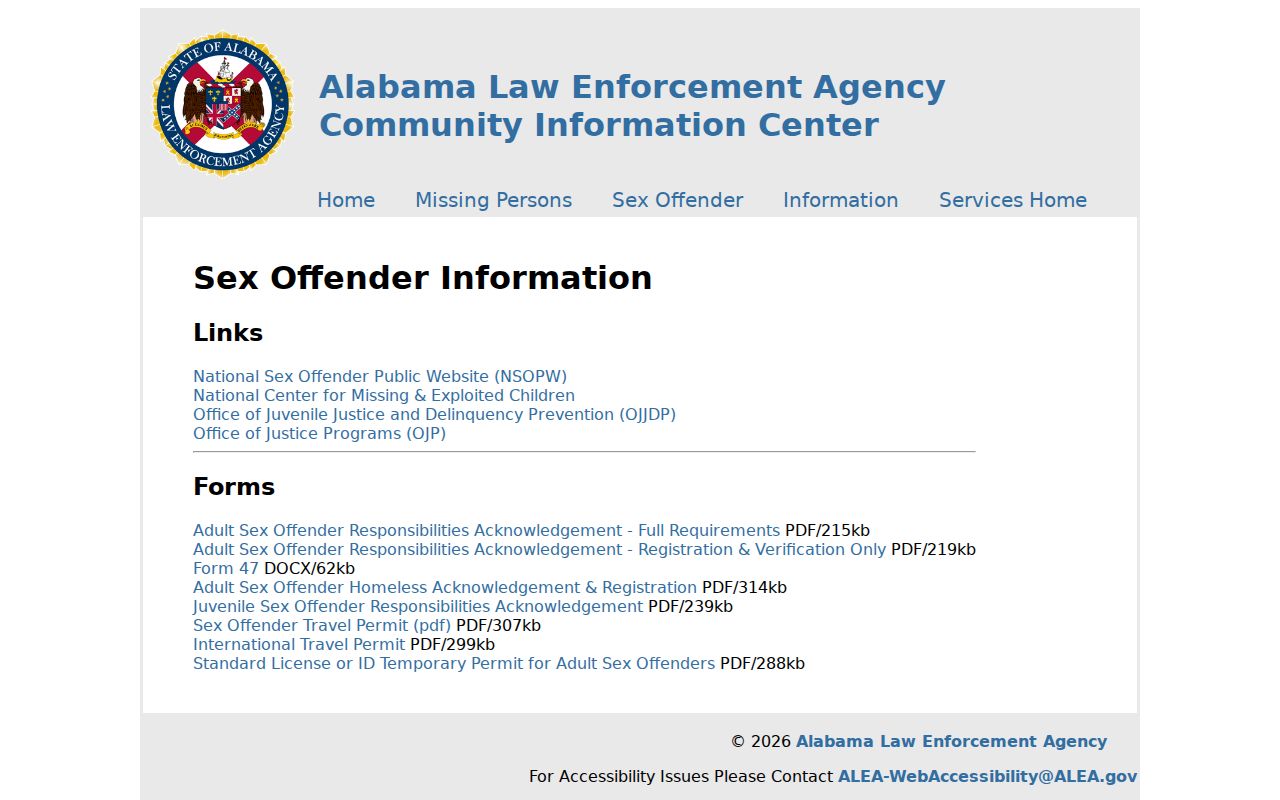
These forms explain the registrant's duties, while the public profile shows only information Alabama law permits the public to see.
Registration Levels and Duties in Alabama
Alabama does not label adult registrants with the federal Tier I, II, and III scheme. SORCNA, the Alabama Sex Offender Registration and Community Notification Act, uses adult and juvenile rules instead. Adult registration is generally for life, subject to narrow relief. Juvenile duration and public notice turn on age, offense, risk, and court action. The table reflects the categories supported in Lamar County research.
| Alabama Category | Duration | Public Visibility |
|---|---|---|
| Adult sex offender | Generally life under § 15-20A-3(b), with narrow relief | Public as Alabama law directs |
| Juvenile 14+ with specified serious offense | Lifetime, with a possible petition after 25 years under conditions | Depends on statutory and court notice rules |
| Other juvenile registrant | Ten years from initial registration | Limited according to risk and court order |
| Juvenile low, moderate, or high risk | Tracks the applicable juvenile duty | Limited school notice, three-mile school/childcare notice, or adult-style public notice |
Adult registrants generally report in person during their birth month and every three months. Certain changes must be reported within three business days. A homeless registrant reports every seven days. Registration generally begins within three business days after release from incarceration or, if there is no incarceration, after conviction.
Those schedules concern reporting duties, not guaranteed website refresh times. Local agencies collect and transmit the information. ALEA maintains the statewide registry.
Lamar Registry Sheriff Contact
The Lamar County Sheriff's Department is the documented local contact for registration and suspected noncompliance. Call 205-695-7470. The research found no official local registration counter address, appointment rule, hours, or fee. Two government sources point to different sheriff-related locations, so calling first is essential. Do not assume that the jail complex or Judicial Center is the correct registration counter.
For a possible reporting problem, give law enforcement a clear account of what was observed. Do not confront a listed person. ALEA's Registry Unit is also available at 334-676-7898 or sexoffenderunit@alea.gov. For Lamar County matters, the sheriff can determine whether the report belongs locally or should go to ALEA or another agency.
Lamar County Sheriff's Department
Registration and compliance inquiries
205-695-7470
Counter location and hours: call to confirm
Note: No verified Lamar County sheriff registry map, online list, alert app, or public registration schedule was located.
Lamar County Registry Notice Distance
Community notice is distinct from an online Lamar County registry search. Under Alabama Code § 15-20A-21, the general notice geography for Lamar County's municipalities under 5,000 people and for unincorporated areas reaches residences within 2,000 feet and schools or childcare facilities within three miles. The responsible agency may mail or hand-deliver flyers. It may also post notice at police or sheriff offices, publish it, or post it electronically.
That local process should not be converted into a promise that every home receives the same notice by the same method. Confirm a specific notice with the responsible law-enforcement agency. Community notification does not replace the public portal, and the portal does not replace local notice.
Residence restrictions are a separate subject. Alabama Code § 15-20A-11 controls principal residence rules. ALEA also explains a 500-foot loitering restriction for certain people convicted of offenses against children under 12 near specified schools, childcare sites, playgrounds, parks, athletic fields, and child-focused businesses. These are statutory duties, not a basis for private enforcement.
Using Registry Information Lawfully
Registry information supports personal, family, and community safety awareness. It should be used to understand public notices, plan calm safety steps, and give suspected noncompliance to the proper agency. A profile is not permission to contact, follow, shame, threaten, or damage the property of a listed person or household.
Alabama's criminal-information laws also restrict false-pretense access and unauthorized communication. Alabama Code § 41-9-601 provides criminal penalties for prohibited access or disclosure of criminal information. SORCNA and general criminal laws may apply to threats, intimidation, harassment, and vandalism. Verify facts with the source office before acting on any public record.
Misuse Can Be a Crime: Never use Alabama registry data to threaten, intimidate, harass, vandalize, or target a registrant or family. Ala. Code § 41-9-601 also punishes specified false-pretense or unauthorized criminal-information access and disclosure.
A suspected Lamar County compliance issue should go to the sheriff at 205-695-7470 or ALEA's Registry Unit. An emergency belongs with 911. Do not investigate on your own.